
7 Inspiring HR Quotes to Motivate Your Management Team
Discover 7 inspiring HR quotes to help managers and leaders improve hiring, motivation, and leadership. Read them and build a stronger workplace culture.

Author: Jisr Team
Category: Human Resource Management
Published on: 10 February 2021
Share this blog with your colleagues
Instead of the most famous saying of all—"Employees don’t quit companies; they quit their managers"—and other sayings that contain a grain of truth but lack merit and accuracy, since many employees leave “companies” for various reasons, such as company culture, a lack of growth opportunities, low pay, or overwhelming work pressure. All of these reasons can apply even when a manager is creative, a capable leader, and someone who inspires their employees’ trust and enthusiasm. Amid the overused and ambiguous quotes, we have scrutinized numerous inspirational quotes for managers and leaders—whether in human resources or other fields—to present you with seven quotes that we consider inspiring for the mindset of a successful manager and effective leader in today’s Saudi workplace across various tasks such as hiring, management, motivation, evaluation, and employee retention.
1. Start with “Why” – Simon Sinek
In his book Start With Why , Simon Sinek presents a method for leading and influencing others that begins by clarifying the purpose of the mission or action, before explaining the outcome—the “What”—and how to carry it out—the “How”—in what he calls the Golden Circle, with the purpose (“Why”) at its center, as illustrated in the diagram below.
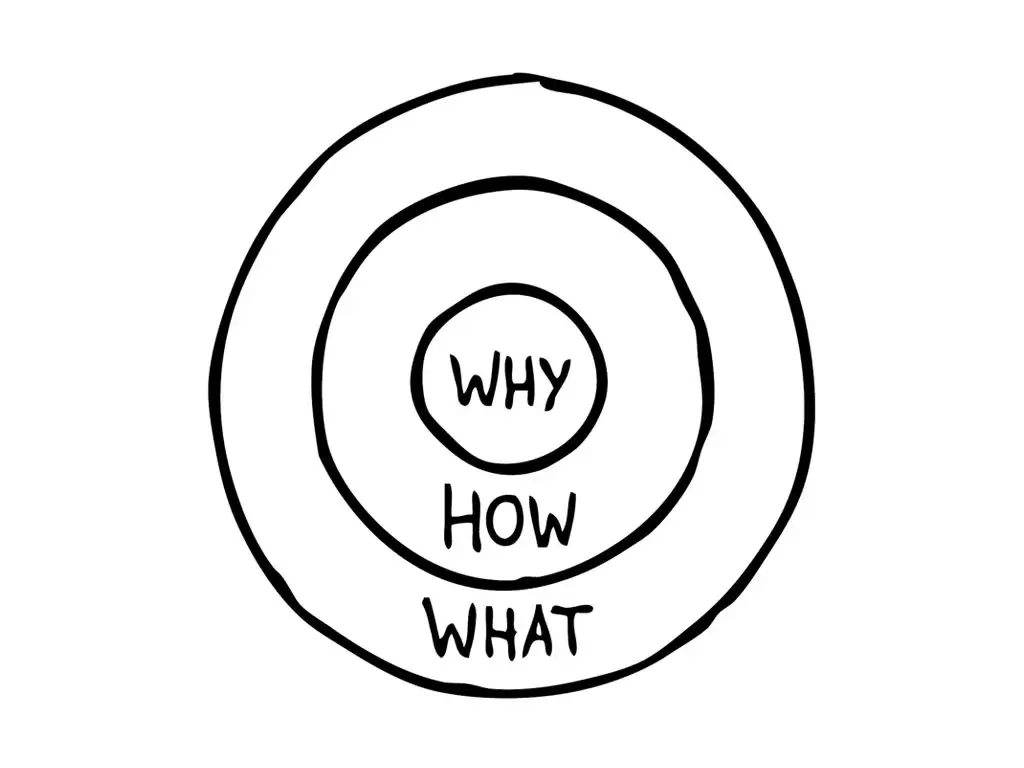
With this circle, Sinek highlights the critical importance of marketing the very reason for a company’s existence in the world before promoting its product or its features. As Sinek believes, “People don’t buy the product; they buy the purpose behind it.”
The same applies to motivating and managing employees; employees work with dedication and consistency when they understand the purpose behind the company’s existence as a whole and their own role within it, and when they believe in that cause.
At Jisr, for example, we believe that strategic human resources play a pivotal and fundamental role in the success of any organization (this is our “why”), so we help HR professionals dedicate 60% of their time to focusing on what matters—such as recruitment strategy, training and development, improving the work environment, ensuring fairness, and boosting productivity (these are the “hows” through which we achieve our purpose). As for the “what,” we offer Jisr to automate human resources for small and medium-sized businesses that complies with Saudi labor law and policies. This is our goal, how we achieve it, and the product through which we achieve it. And that’s exactly what it takes to keep us passionate about what we do.
2. If you can’t align human resources efforts to contribute to the organization’s commercial success, no one will listen to you — Anonymous
This saying applies to nearly every department in the organization. Marketing works to achieve the company’s business strategy by promoting its products or services; “Production” or “Development” also strives toward the same goal but through the production or manufacturing of the product; and so does “Human Resources.”
However, when it comes to Human Resources, it’s easy for HR managers to overlook their role within the company because of the sensitive nature of their work and the fact that they deal with “people” rather than products or ideas of various kinds. Therefore, we wanted to remind you that the role of human resources in a company or organization is to achieve its goals through its employees and talent—whether through recruitment, evaluation, training and development, financial incentives, and so on—covering the full range of HR functions in companies.
Human resources professionals typically pursue studies in business administration and commerce through an MBA program or simply upgrade their qualifications through internationally accredited human resources certifications to ensure they have a thorough understanding of their work and the ability to integrate seamlessly with other aspects of business management.
3. Train your employees enough so they can leave, and treat them well enough so they don’t have to—Richard Branson
This quote from Richard Branson is as famous in the world of management for its accuracy and wisdom as it is for its contradiction of most managers’ and leaders’ beliefs. Some companies typically retain their employees by restricting their other employment opportunities with competitors—whether by withholding opportunities or by limiting their skills and hindering their professional advancement. This strategy is not only ineffective in today’s open business world, with its diverse and flexible opportunities, but it is also unethical.
Therefore, the optimal strategy for retaining employees must be based on the employees’ own choice to stay voluntarily. This strategy includes identifying and fulfilling employees’ key priorities within the company, as well as other tactics for retaining talent—all of which reflect the principle embodied in the saying.
Maintain transparent and attentive communication with your employees so that you stay informed about their ambitions and aspirations, allowing you to stay one step ahead and keep them motivated to stay with your company even when they receive job offers from elsewhere.
4. Often, your worth as a manager depends on your ability to hire competent employees and then get out of their way—Tina Fey
Fey is no stranger to leading high-performance teams; the American actress and writer has achieved numerous successes in film, comedy, acting, and writing. This quote aligns with a statement by the famous entrepreneur and Apple co-founder, Steve Jobs, who noted that it makes no sense to hire smart, talented people and then tell them what to do; we hire talented people so they can tell us what we should do.
The effectiveness of this saying becomes evident when a manager or leader recognizes their own weaknesses—a commendable trait—and realizes that it is best to step back and make way to competent employees who possess the skills and knowledge that the manager may lack. This shows that great leaders clearly understand their strengths, but they devote the greatest effort to understanding their weaknesses.
5. Your best qualities are often your worst flaws — Anonymous
Many dedicated managers fall into the trap of feeling responsible for “changing” their subordinates’ personalities for the better—on the one hand, to improve work and efficiency, and on the other, to help their subordinates grow and improve. Phrases such as the following are often repeated: “You’re disciplined and meticulous in your work, but you lack creativity” or “You have an impressive ability to handle many tasks at once, but you make too many mistakes.” When these statements are used to motivate an employee to improve and address their weaknesses, they are ineffective and may even make matters worse. Why?
Because, in the first example, for instance, the employee’s lack of creativity is precisely what makes them disciplined and meticulous in their work to begin with. The employee’s personality tends to view things as they are—rationally, logically, and through realistic calculations. Consequently, the “flaw” and the “strength” are two sides of the same coin. You cannot (in most cases) have an employee’s precision in calculations and realism without them lacking imagination and creativity. The same applies to the second example: the employee makes frequent mistakes because they are juggling too many tasks at once.
Although this is not a universal rule, it is very useful for managers, especially human resources managers. A smart manager understands that every personal strength in their subordinates is matched by a weakness or shortcoming. A manager’s role is to place each employee in the right position where their strengths and advantages shine, rather than the opposite. Likewise, they must take into account the strengths and weaknesses of their team when hiring a new employee to join the team.
6. “Done is better than perfect; completing a task well is better than doing it perfectly”—Sheryl Sandberg (adapted)
Of course, this quote does not mean neglecting the quality of work or failing to do it well; rather, it addresses a problem other than “negligence” or “inaction.” This saying is directed at those who strive for perfection to the point that they end up accomplishing very little. Consequently, they seek continuous improvement and absolute perfection in their work, and when they fail (like the rest of us) to achieve it, they become frustrated and accomplish nothing. This perfection is usually tied to continuous improvement in one’s work and has nothing to do with the required quality of the work itself. Therefore, when you find that you can complete the work to an acceptable standard, do that first before seeking to make further improvements.
This saying is closely linked to the famous rule: “If you can’t achieve it all, don’t abandon it all.” It also addresses employees who strive for perfection to the point where they refrain from making even partial improvements or developments because they won’t settle for anything less than achieving complete perfection all at once. As much as the pursuit of perfection drives managers toward improvement and development, it can also destroy productivity and hinder progress in the business world as well as in personal life.
7. To win in the business world, you must first win in the workplace—Doug Conant
Under Conant’s leadership, Campbell Soup rebounded after a decline in its market capitalization, improved its financial position, and advanced its diversity and inclusion policies, ultimately putting the company back on track. Doug realized the importance of earning his employees’ trust and loyalty when he took the helm immediately following a major wave of layoffs.
The layoffs had an unprecedented negative impact on team morale and spirit. Doug realized then that to achieve any success in the marketplace, he must first succeed in the company’s relationship with its employees and talent in the broader job market—especially since raising wages alone is not enough to motivate employees and build loyalty to the company.
Finally, we recognize that the effectiveness of sayings and quotes in the business world depends on many different contexts and factors, and it is nearly impossible to generalize any single saying to all contexts and situations. Nevertheless, they serve as a powerful tool for recalling wisdom in various situations and inspiring others. We hope you enjoy reading these sayings as much as we enjoyed compiling and commenting on them for you.
Related Blogs
 Human Resource Management
How to Prepare an Internal Employee Handbook?
 Human Resource Management
A guide to calculate annual leaves according to the Saudi labor law.
 Human Resource Management
4 Major HR Challenges, Solved by Jisr
Stay up-to-date with the latest HR trends, technologies, and tips!
Looking for the latest insights on HR topics like hiring, performance, metrics, and more? Receive the latest insights to help you find, onboard, develop, and retain your employees in your inbox now.