
Applicant Tracking System (ATS): A Complete Guide for HR Teams
Receiving hundreds of job applications doesn't guarantee you'll find the right candidate. Learn how an ATS helps companies organize hiring and make faster, more accurate decisions.

Author: Jisr Team
Category: Recruitment
Published on: 7 June 2026
Share this blog with your colleagues
How do you know whether a candidate is the right fit for a role? It sounds like a simple question, until you receive 500 CVs in a single week for one job, scattered across email, WhatsApp, and Excel, with no clear record of how many applicants you have actually contacted. Between the delays and the duplicated effort, this hidden cost is exactly why most companies struggle to hire well and why so many now invest in a powerful applicant tracking system (ATS).
This guide explains what an applicant tracking system is and why it matters, how it works, how it benefits Saudi companies, and how to choose the right system for your business.
What Is an Applicant Tracking System (ATS)?
ATS stands for Applicant Tracking System. It is software built to manage the entire hiring process, from the moment a manager requests a new role, through preparing the job page and job description, publishing the ad, receiving and screening applications and CVs, evaluating candidates, and on to interviews, sending offers, and handing the new employee over to the team and adding them to your systems. It brings all of this together in one place, giving you a complete view of every hiring decision in your company.
ATS vs. Manual Hiring: What's the Difference?
Benefits of Using an ATS to Improve Recruitment
Recruitment systems help companies overcome common challenges and deliver a wide range of benefits, including the following.
Automate Hiring From Requisition to Offer
Application volumes have reached a point where they are difficult to handle manually. In 2025, applications submitted through LinkedIn grew by more than 45%, reaching roughly 11,000 per minute. Amid that volume, hiring teams drown in applications every day, and many of those applications are not a fit for the role in the first place. This is where an ATS comes in: it lets you screen applications and manage hiring faster and more effectively, filter out unqualified candidates, and reduce the impact of AI-generated applications.
Track and Manage Applications in One Place
The biggest problem companies face in hiring is a lack of visibility. The process drifts along in a fog, and sometimes even the HR lead does not know the details. Instead of tasks being split across different tools and people with no clear definition of roles and responsibilities, an ATS brings everything together in one place. It lets you analyze and track applications, organize them, and bring them into a clear workflow with transparency and consistent expectations. The result is faster time-to-fill and a team freed up to focus on the decisions that matter rather than routine work.
Improve the Candidate Experience
The candidate who applies to you today will apply to someone else tomorrow. And if they go through a poor hiring experience, there is a strong chance they will share it with people in their professional network. That affects your company's reputation and its ability to attract talent in the future, especially in the Saudi market, where the professional community is closely connected, whether in social gatherings or in LinkedIn groups. Add to that the fact that the talent pool in the Kingdom is relatively limited in certain sectors, such as tech.
That is why the best recruitment software helps you strengthen your market reputation and attract talent by streamlining processes and enhancing the candidate experience in ways that reflect your professionalism and image. A candidate who feels valued will speak positively about you (indirect marketing for you) and maintain the relationship, which increases the chance they will reapply if you open a more suitable role later.
Reduce Your Cost-per-Hire
Since we are talking about the difficulties, challenges, and benefits, we cannot ignore the cost of hiring, which rises sharply as the business grows. The bigger problem is that companies cannot know exactly where and how their recruitment budget is being spent. Put simply, any process without a system becomes haphazard and cannot be measured. With a professional recruitment system, by contrast, you get a clear picture you can use to develop your hiring plan, reduce costs, and increase efficiency and productivity.
How Does an ATS Work?
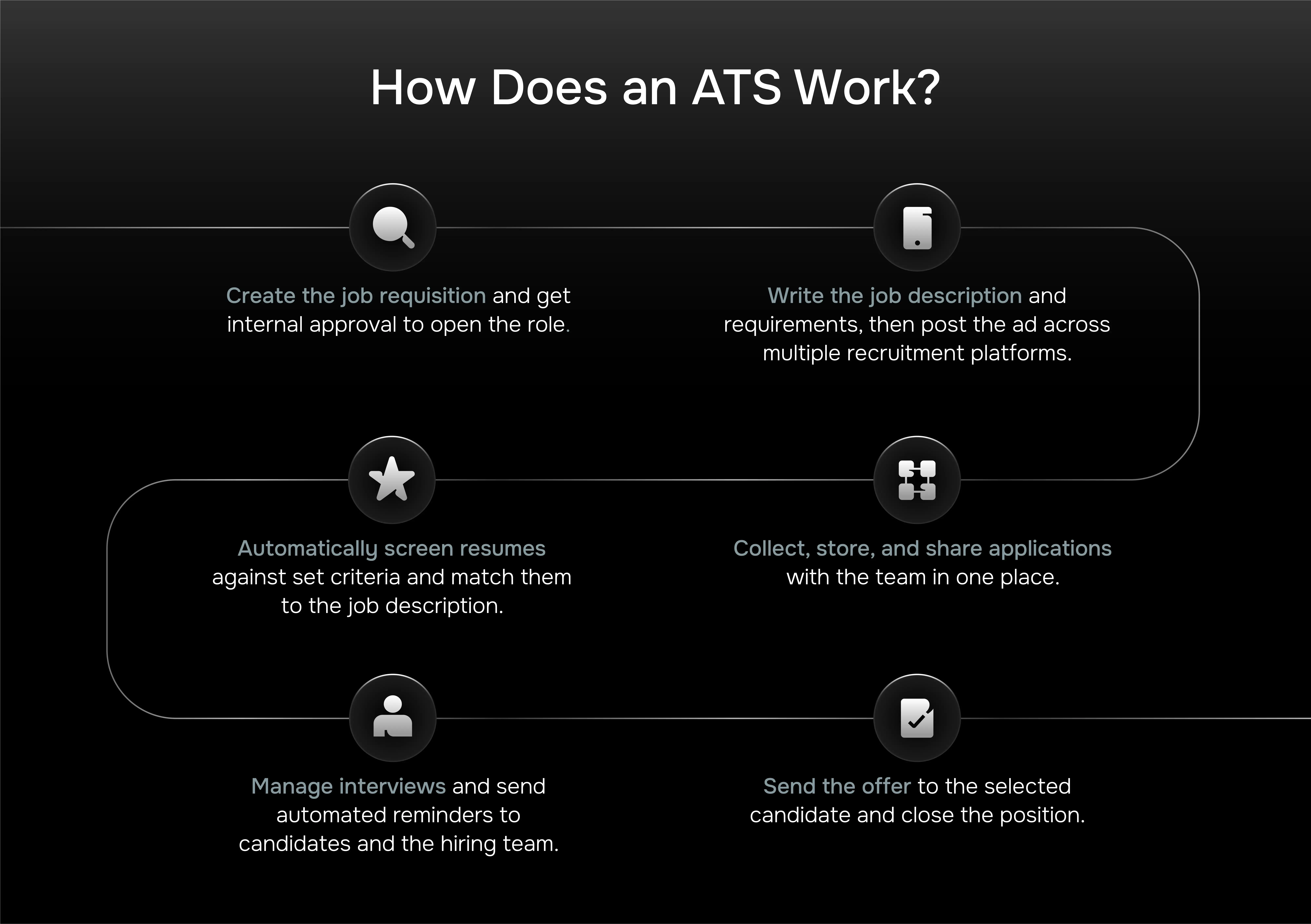
Some people see receiving 800 applications in a week as an achievement, until it is time to screen them and they grasp the difference between "posting a job" and "managing hiring." Anyone using an ATS does not have to worry about that, because the system handles the entire process from start to finish, as follows:
Stage 1: Job Requisition & Internal Approvals
The process begins the moment a department manager submits an internal request specifying the required role, budget, hiring timeline, and core skills. The system then turns that request into a standardized form, which is approved by the CFO or CEO before it reaches the hiring team.
Stage 2: Job Posting & Distribution
Once the job description is ready, which is now generated automatically with AI instead of being written by hand on every platform, the ATS lets you publish the role across every recruitment channel and source, such as LinkedIn, external job boards, and others, while tracking each channel's performance in terms of the number of applicants and their quality.
Stage 3: Application Intake, CV Parsing & Screening
Every CV submitted through the application page passes through a parsing engine that extracts the key data, such as name, specialization, years of experience, skills, and certifications, to make it searchable rather than just a set of PDF files. After that, the system ranks and classifies candidates automatically based on the criteria you defined in advance, from the closest match to the job description to the furthest. This way, hiring managers can view a ranked list, rule out unqualified candidates early, and begin the selection and shortlisting process.
Stage 4: Evaluation & Interviews
After selecting a specific group of qualified candidates, the ATS enables the hiring team to evaluate each candidate and collaborate, consolidating all assessments in one place. This reduces bias and standardizes evaluation criteria. It also helps you schedule and manage interviews easily, by sending automatic links and emails that show available time slots, simplifying coordination instead of the chain of scattered emails and messages needed to agree on a single time.
Stage 5: Offer Management
Finally, once evaluation and interviews are complete and you have reached an agreement with the candidate, the system sends them the job offer. As soon as they accept and sign it, you can transfer the employee's data to your other systems, document the contract, and begin onboarding the new hire.
How Does an ATS Read and Rank Resumes (CVs)?
An ATS does not read a CV the way an ordinary person would. It goes through three stages:
- Text extraction: It converts the PDF or Word file into raw text. At this stage, some elements of the CV may not appear or may disappear entirely, such as certain images, complex tables, and unsupported fonts.
- Section parsing: The system attempts to identify the core sections (experience, education, skills, contact details) using familiar patterns.
- Keyword matching: It searches for the keywords defined in the screening criteria and assigns each CV a ranking score based on a defined model.
For Job Seekers: How to Write an ATS-Friendly Resume
If you have reached this section because you are applying for a job, here are some quick tips for an ATS-friendly CV:
- Use Word or PDF files with text that the system can extract and recognize, not images.
- Keep section headings clear and direct, such as "Experience" and "Education," and avoid unconventional headings.
- Write the job title in the same form used in the ad (an exact match wherever possible).
- Avoid complex tables, images, and icons as replacements for headings and sections.
- Put your contact details at the top of the page on one clear line (name, mobile, email).
Key ATS Features for Saudi Companies: What Matters Locally
Hiring needs in Saudi Arabia differ from one company to the next, just as they differ from one country to another. Still, the core features required locally in a recruitment system are as follows.
Resume Parsing & Candidate Screening
This is the most important feature in recruitment software in Saudi Arabia. An ATS automatically parses CVs, extracts candidate data, and presents it in organized profiles. This saves long hours of manual work, lets you quickly rule out unqualified candidates, and lets you focus your search on the skills you need.
Job Ad Creation & Multi-Channel Posting
The goal of any system is to reduce effort, speed up the process, and minimize human involvement in routine tasks as much as possible. The same applies to an applicant tracking system, which lets you write a job ad once and publish it across all recruitment platforms with a single click, adapting the ad to each channel's nature so it reaches the widest audience and is more effective. It also lets you manage and update all of your job ads from one place.
Candidate Experience & Talent CRM
An applicant tracking system provides tools to engage with candidates, including a relationship management system, candidate tagging and grouping, automatic follow-up reminders, email newsletters about new roles, and a complete record of your company's interactions with each candidate. For example, you can see which candidate you interviewed before, who reached the offer stage and declined, and why they declined. This way, the system gives you direct, effective communication with your talent pool, which you can draw on before opening vacancies to the public.
Team Collaboration & Role-Based Permissions
Hiring is a team effort. That is why modern ATS platforms provide an environment for collaboration, with features such as easily adding job requisitions, mentioning colleagues or inviting them to review a candidate or CV during the screening and evaluation stages, shared evaluation forms and feedback, and the ability to leave comments and peer ratings.
It is true that more than one person is involved in the hiring process, but there is still a need for privacy regarding access to the data and the process itself. That is why the system offers role-based permissions to ensure that sensitive information (such as salaries or internal notes) is seen only by the relevant people. For example, you can grant a hiring manager permission to review candidates and write notes, while moving them to the offer stage remains restricted to the HR team. This speeds up decision-making and keeps everyone informed.
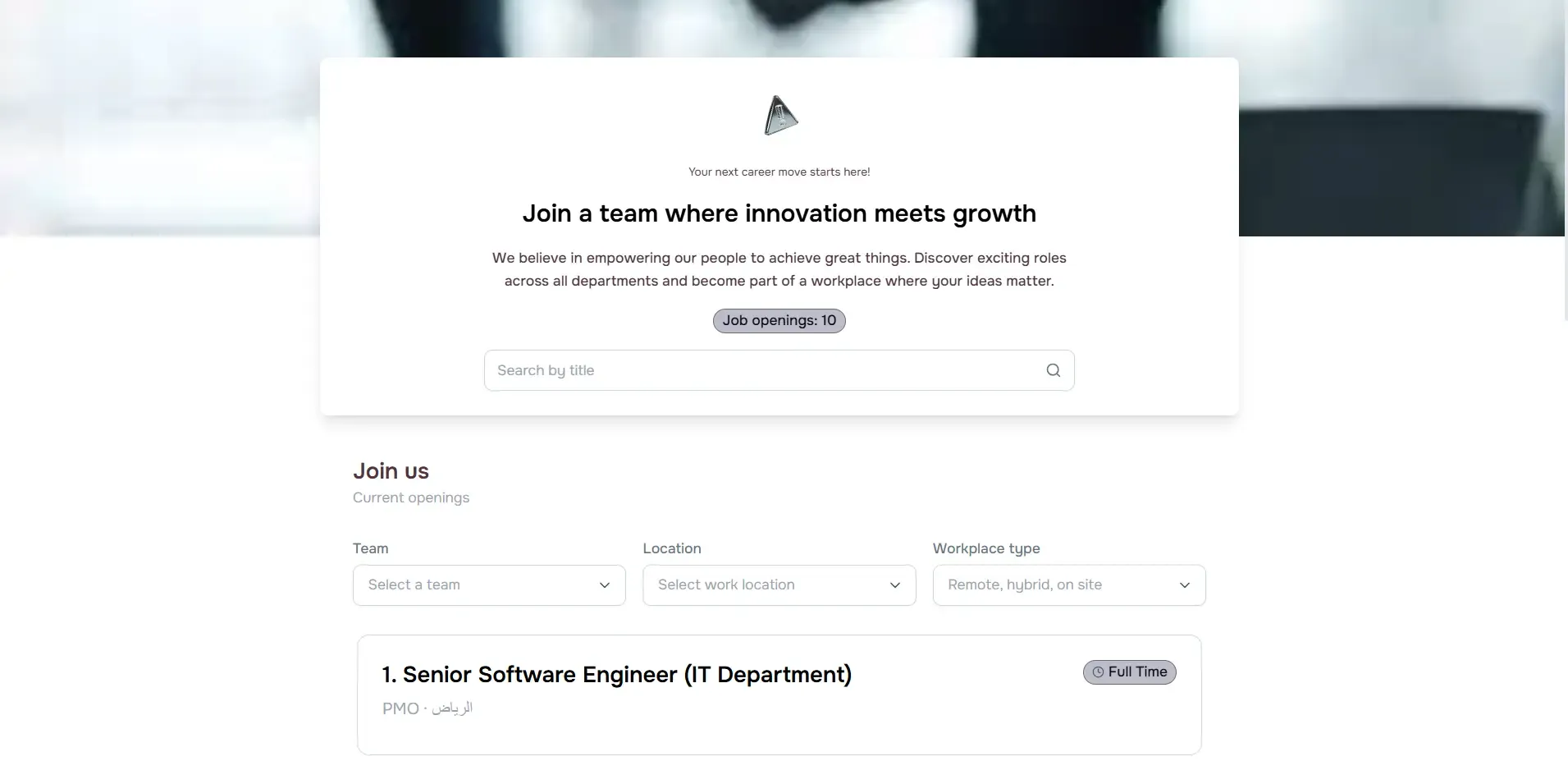
Careers Page & Employer Branding
Your employer brand is like your commercial brand: you have to invest in it and market it just as you do your commercial brand. Recruitment software lets you build a strong employer brand by providing features to create a careers site, page, and job listings in a way that reflects the company's values, mission, principles, and culture, with integration into web analytics platforms to measure visitor sources and the conversion rate from visits into submitted applications.
A study published in 2025 on Generation Z in the Saudi oil and gas sector found that the psychological relationship with the employer and alignment with its organizational identity were among the strongest factors influencing the intention to apply and to stay in the role, more so than salary itself in many cases. In other words, the first impression a candidate forms from your careers page is an important factor in attraction.
Structured Interview Scheduling & Evaluation
You will not understand how hard it is to coordinate a time with several people you do not know all at once until you try to organize a job interview, between the emails and WhatsApp messages, the apologies and requests to reschedule, the slow replies, and even the difficulty of reaching the location, on top of the issues people face if the interview is remote.
This is a nightmare for a recruiter, let alone for someone who lives it every day. An ATS improves interview scheduling and management by simplifying and fully automating the process. The employee or recruiter only needs to show up at the time the system has set based on available calendar slots. The system sends them the interview details and location, and if it is online, it sends a meeting link from video platforms (Zoom, Microsoft Teams, and Google Meet), so the candidate joins the interview through a single link without installing additional apps.
Recruitment Reports & Hiring Metrics
The well-known management principle "what gets measured gets improved" applies here. Modern systems provide data, numbers, and analytics, and let you build a custom reporting dashboard that includes the metrics that matter for hiring success, such as average time-to-fill per role, cost-per-hire by recruitment channel, the rate at which candidates complete the hiring stages, and the attrition rate among people hired through the system, all of which can be displayed and shared easily with others.
Mobile Access
Hiring is not a fixed nine-to-five job. A candidate or an employer may call you outside working hours, and you may have to follow up and send an offer on a weekend. Modern recruitment software provides mobile apps that let the HR lead and hiring manager follow up on, manage, and review applications; send notes and approvals; and even make decisions and conduct phone or video interviews, recording the evaluation directly in the system via the mobile app.
Integration With Government Platforms
HR and recruitment play an important role in a company's compliance with labor law. That is why ATS platforms provide direct integration with government systems and platforms, such as Qiwa, GOSI, Mudad, Muqeem, and others.
ATS and Saudi Labor Law Compliance in 2026
Labor laws and regulations are constantly evolving to improve the contractual relationship and the labor market in the Kingdom. Applicant tracking systems make a point of keeping pace with the latest updates, so that organizations stay compliant automatically and continuously in the following ways.
ATS Integration With Saudi Platforms: Qiwa, Mudad, GOSI, Muqeem
Recruitment software integrates with Qiwa, the unified legal record for labor relationships, to issue digital contracts, manage work permits, and calculate the Saudization rate (the Nitaqat program).
It integrates with Mudad, the payroll and Wage Protection System (WPS) compliance platform, to verify that the salaries paid by the bank match the documented contracts.
GOSI automatically registers Saudi employees as soon as a contract is created on Qiwa and deregisters them when the contract ends.
And through Muqeem, the database of non-Saudi employees' residency permits, which includes residency validity, registered profession, and work license.
The integration between these platforms and the ATS saves significant time and effort. For example, the compliance rate on Mudad directly affects an organization's classification in the Nitaqat program on Qiwa, which in turn affects its ability to issue new work visas. Likewise, Qiwa contracts that are not registered with GOSI do not count toward the Nitaqat program. And if an employee's residency in Muqeem expires, they lose their status as an active employee, regardless of their standing on Qiwa. Seamless integration between these platforms and the recruitment system gives you greater peace of mind and time so that you can focus on hiring strategy rather than the technical side.
Nitaqat (Saudization) Compliance
The Ministry of Human Resources and Social Development (HRSD) has announced the launch of a new phase of the Nitaqat program, which will run from 2026 to 2028. The new phase increases the "c" coefficient used to calculate the required Saudization rate for most sectors, potentially changing a company's classification. While an ATS cannot "raise" the Saudization rate on its own, it does simplify the administrative process and contribute to raising it by:
- Distinguishing Saudi candidates from non-Saudis from the moment of application.
- Showing the projected Saudization rate for each department if you hire the current candidates.
- Providing professional Saudization reports.
- Sending automatic alerts before dropping out of the green band, accompanied by recommendations such as pausing the hiring of expatriates temporarily, or accelerating the hiring of Saudis.
Candidate Data Protection (PDPL)
The Personal Data Protection Law (PDPL) applies to candidate data within the general framework, without a separate law for it. The law requires that you:
- Collect data for a specific, declared purpose, without using it for another purpose except with consent (for example, you may not use candidate data in marketing or commercial ad targeting).
- Delete data as soon as its purpose has been fulfilled.
- Respond to immediate deletion requests.
- Notify the supervising authority within 72 hours of any data breach.
Fines for violations can reach SAR 5 million, and penalties include up to 2 years' imprisonment for unlawful disclosure or for transferring data outside the Kingdom without permission. A Saudi ATS helps you with all of this, from collecting the data to obtaining the candidate's consent to process it, documenting the purpose for which they agreed, and enabling them to withdraw consent at any time.
The Financial ROI of an ATS
The HR team is looking for speed and efficiency, while the finance team is focused on the numbers and the budget. To justify the cost of recruitment software, you can calculate the return on investment using the following metrics.
1. Metric one: Cost per Hire
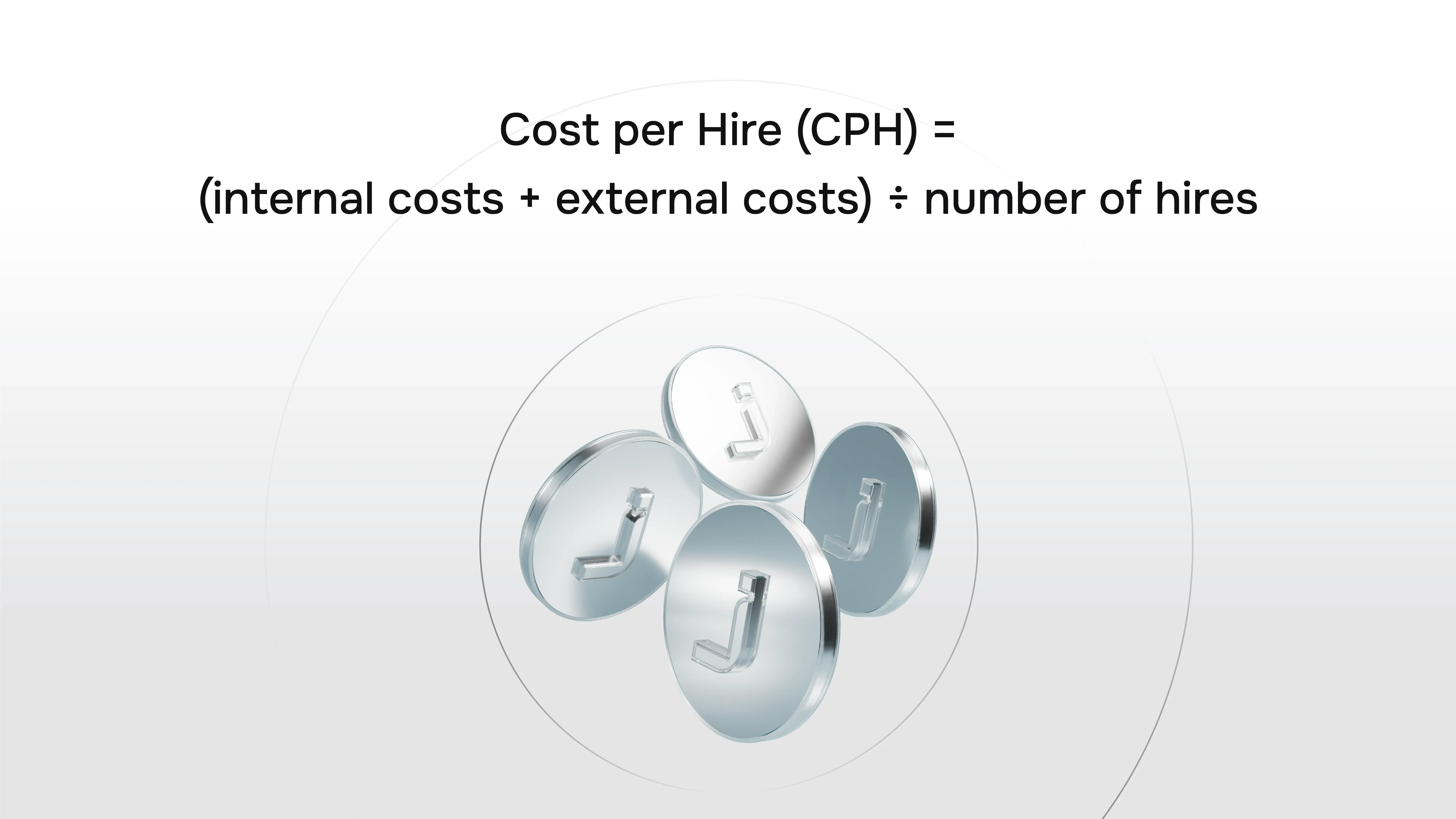
Cost per Hire (CPH) = (internal costs + external costs) ÷ number of hires
Cost per hire is split into two parts:
- Internal costs: the salaries of the hiring team, the infrastructure dedicated to hiring, and interview time.
- External costs: job ads, agency fees, screening and assessment tools, and candidate relocation costs.
The global average cost per hire for a non-executive role is $4,700 (roughly SAR 17,600). In Saudi Arabia, the figures vary by sector and organization size, ranging from SAR 8,000 to SAR 25,000 for non-executive roles and rising to SAR 40,000 to SAR 80,000 for executive and specialized roles, especially in the tech, banking, and healthcare sectors. This is due to several factors, such as the cost of advertising on local recruitment platforms, recruitment agency fees that can reach two months' salary in some cases, and the cost of aptitude tests and psychometric assessments, which have become standard at large companies.
2. Metric two: Time to Fill
Time to Fill = the number of days between approving the job requisition and the candidate accepting the offer
This is considered one of the most important indicators of hiring quality in companies. The global average time-to-fill is 44 days. The hiring market is tough, and competition for talent intensifies in critical sectors such as tech, finance, and consulting. Every day of delay in hiring raises the chance that the candidate accepts an offer from another company. After that, you reopen the same role for an additional month and pay the cost of hiring twice.

How to Choose the Right ATS for Your Company
The decision to choose a recruitment system or software is critically important for the HR department and the company. Its impact lasts for three to five years, and the cost of switching between systems is high, disrupting the workflow. That is why, before you buy any system, you need to think it through and answer clearly. Here is a framework and a set of questions to help you decide.
Questions to Ask Before Buying an ATS
Before you begin searching for an ATS, make sure you have clear answers to these questions:
- What is the size of your current hiring needs? And how much will it grow over the next five years?
- Which job-posting platforms do you currently use, or plan to use in the future?
- Which manual processes slow down your hiring?
- At which stage do candidates drop out of your hiring process most often?
- Which hiring metrics do you want to measure and track?
- Which repetitive tasks consume the most time from your hiring team, and should the system take over?
- What is your budget? And how large is the team that will use the system?
ATS Evaluation Criteria: How to Buy the Right System
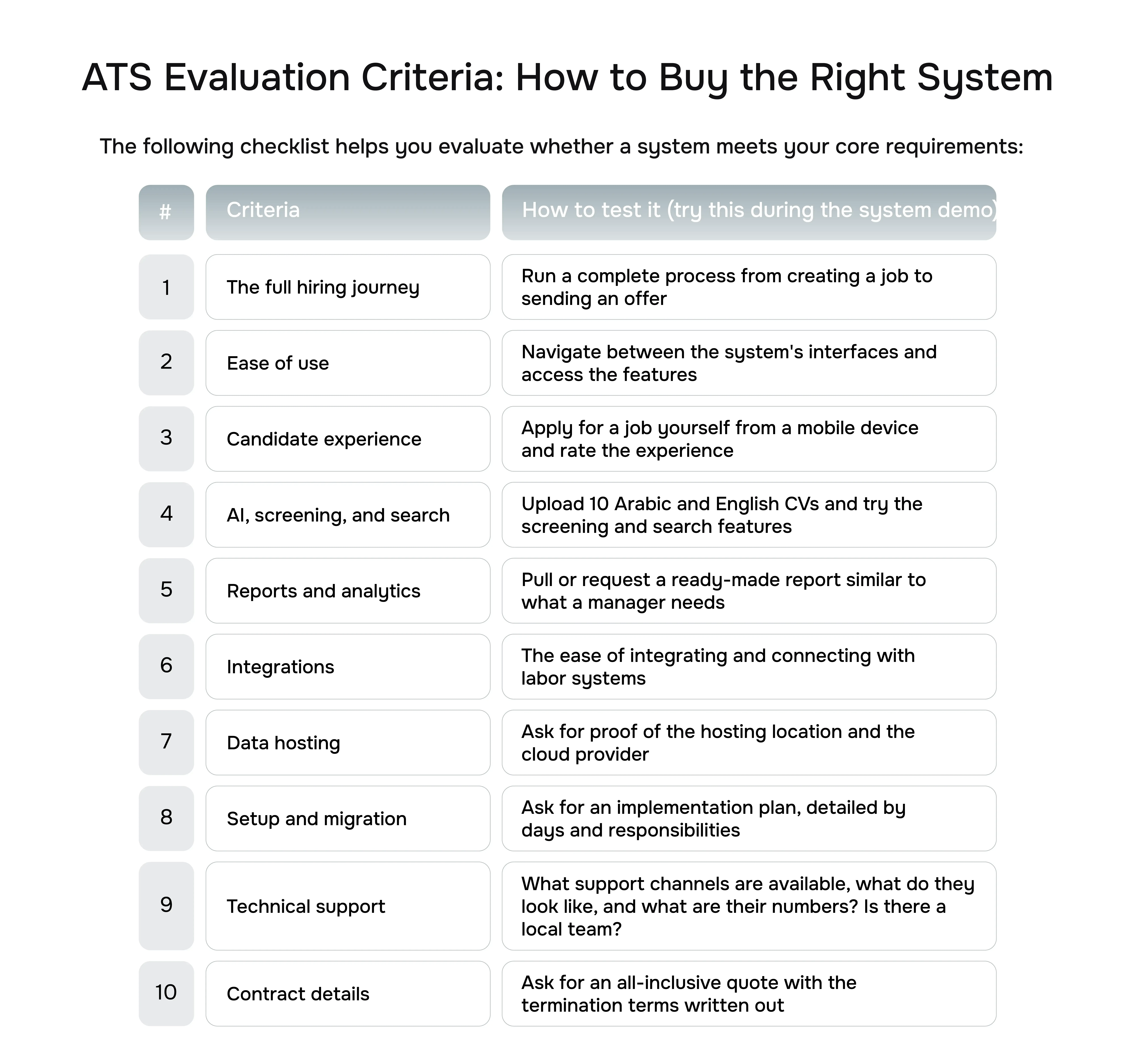
The following checklist helps you evaluate whether a system meets your core requirements:
1. The Full Hiring Journey
The system must cover the hiring journey from start to finish: from the job requisition and job posting, through application receipt, screening, interviews, and evaluation, to sending the offer and closing the role. You can evaluate this stage by asking the vendor to run a complete hiring journey in front of you during the demo, from creating a new job to sending an offer to a candidate. Note any step they skip, or describe as "needing to be set up later," and treat it as a gap.
2. Ease of Use
Ease of use for the hiring team is measured by the number of steps required to complete daily tasks, such as adding a candidate, moving an application from one stage to another, scheduling interviews, sending notes, and collaborating day-to-day. A good system keeps these tasks to two or three steps, not five or seven. You can measure this by giving a non-technical employee three specific tasks and seeing whether they can complete them without a long explanation from the vendor.
3. Candidate Experience
The application experience directly affects the number of qualified candidates who complete the application. The number of required fields, the ability to apply smoothly on mobile devices, the ability to upload a CV, and the clarity of messages and notifications are all influential factors. That is why you must take this criterion into account when you evaluate the system. You can assess it by applying for a job yourself from your phone and rating the experience from the candidate's perspective, not the employee's.
4. AI, Screening, and Search Features
This is the most heavily weighted area because it is the dividing line between good systems and systems that use "AI" merely as a marketing phrase. It covers three aspects:
- The accuracy of CV screening.
- Real AI applications such as matching, summarization, candidate analysis, and job description writing.
- Keyword search, advanced filters, saved searches, and the accuracy of the results.
You can evaluate this aspect of the system by uploading a varied set of CVs (Arabic and English, with compound Saudi names and Arab universities), asking it to apply AI directly to real roles from your company, searching for a candidate with specific experience, and then comparing the results by hand to check their accuracy.
5. Reports and Analytics
Good reports answer important questions rather than just displaying information. For example, good data is the kind that tells you how long it takes to fill a role, how good the applications are from each platform, at which stage candidates disappear, and how the performance of your recruiters compares. During your trial of the recruitment software, you can try to request or pull a ready-made weekly report similar to what an executive needs. Does the system let you build and customize reports flexibly?
6. Integrations
A good system provides easy, seamless integration with your core systems and work applications, saving time, effort, and costs, so you do not need a technical person or manual work to complete a given task.
7. Data Hosting
You have the right to ask where employee and candidate data is hosted. Is there official documentation for the hosting location and cloud provider? Can you choose the geographic region in line with Saudi compliance requirements? Ask for an official document proving the hosting location and the cloud provider, and do not settle for a verbal answer.
8. Setup and Migration
You need to know how long it will take to implement and set up the system, the plan for migrating data from your current system, how your team will be trained, and how the stages and permissions will be configured. This is the most important stage, and the one where installation can be delayed if anything goes wrong. Ask for an implementation plan detailed by days and responsibilities, specifying what falls under the vendor's responsibilities and what falls under your internal team's.
9. Technical Support Model
The most important thing the systems provide, and what sets one recruitment system apart from another, is the technical support experience. That is why you must check the support channels (tickets, live chat, phone, WhatsApp) the vendor provides, the average response time, the operating hours, the presence of a local team in the region, and the availability of Arabic support, and so on.
10. Cost and Contract
Now that you have confirmed that every aspect of the system suits you, it is time for costs and contracts. The cost of recruitment software in Saudi Arabia varies from one vendor to another. You must confirm the estimated costs and the terms of the agreement before you sign and implement the system, through the following aspects:
- Total cost: inclusive of the subscription, system installation, training, migration, integrations, support, add-ons, and fees for additional users.
- Contract and exit: How do you terminate the agreement? What are the data-export fees? What is the retention period? In what format is the data delivered? How is it deleted after termination?
Standalone ATS vs. Integrated HR Suite: Which Fits Your Company?
The question facing any company before it buys new recruitment software is this: do you choose a system specialized in recruitment (a standalone ATS), or rely on recruitment within an integrated HR system (HRMS/HCM)? The answer is not fixed. It depends on the company's size, annual hiring volume, the maturity of your hiring process, and your technical team's readiness to manage integrations.
But the fundamental difference between the two options is as follows.
Systems specialized in recruitment are built for one purpose only: hiring. This makes them advanced in:
- More accurate CV screening, especially with a high volume of applications.
- Deeper collaboration tools between the hiring team and department managers (interview kits, structured evaluation forms, scorecards).
- Detailed analytics for each channel, each stage, and each recruiter.
- High flexibility in designing hiring stages for each role or department.
Integrated HR systems (such as Jisr), by contrast, bring the entire employee lifecycle together in a single system: recruitment, payroll, attendance, leave, performance, and employee files. As soon as a candidate accepts, their data moves directly into a complete employee record, with no duplicate entry and no need for external integration.
The more important question here is: do you need this level of specialization in recruitment, or is a system that covers 80 to 90% of your needs enough? This is the fundamental trade-off between depth of specialization and seamless data, and it needs to be clear before you decide:
The prevailing trend in the market is to rely on integrated suites, not because they are technically the best in every detail, but because the cost of the system, or what is called the total cost of ownership (TCO), is noticeably lower. One subscription, one contract, one support team, and one installation process.
The Future of Recruitment Software and AI
The question you need to ask before you buy any system today is: Will this system serve us over the next five years? Or will you find yourself back in the market within two years, searching for an alternative?
The market is changing quickly, and the gap between systems that genuinely rely on AI and those that don't is widening, especially as HR teams come to rely on AI as a core part of their day-to-day work. The use of AI in HR tasks rose from 26% in 2024 to 43% in 2026, indicating a shift from experimentation to operational use. Among the most important new trends for integrating AI into recruitment are the following.
1. Predictive Analytics: From Reactive to Proactive Hiring
Traditional systems give you a picture of the past: how many roles you filled, how long hiring took, and what it cost. Modern systems move the recruitment function from descriptive analysis to predictive analytics, giving you answers to forward-looking questions:
- Which candidates are most likely to succeed in the role?
- Which new hires might leave within the first 12 months?
- Which recruitment channel will bring you the best candidates in the coming period?
- When will skills gaps appear in your team, and how early should you start hiring?
The leap here is not only in speed, but in transforming the recruitment function from an operational department that responds to requests into a strategic function that anticipates the company's needs 12 to 18 months ahead.
2. Interview Intelligence: Turning Tacit Knowledge Into an Asset
One of the oldest problems in hiring, and one of the most costly in the long term, is the loss of tacit knowledge. Every interview leaves important impressions and notes, but these usually stay in the interviewer's mind or are written up haphazardly in an email or a forgotten Word file. As employees move on or teams change, this organizational expertise is lost entirely, and the company rebuilds its knowledge from scratch with each hiring cycle. Modern recruitment systems solve this problem by:
- Recording interviews (with the candidate's consent, in compliance with the Saudi Personal Data Protection Law).
- Converting speech to text with high accuracy in both Arabic and English.
- Summarizing the interview automatically and extracting the key points.
- Linking the notes to the predefined evaluation criteria.
The result is searchable, analyzable data that lets you return to it later and answer questions that were not possible before, such as:
- What traits did the candidates we rejected have in common, who later proved successful at competing companies?
- How have salary expectations for the same role changed over the last 18 months?
- Which hiring managers have the highest Quality of Hire, and what is different about their approach?
3. Candidate Verification & Fraud Prevention
This trend is the most necessary and the least discussed in the Arab context. The figures indicate that 72% of recruiters have come across AI-generated CVs, 59% of hiring managers suspect that candidates use AI tools to mislead during the application process, and 62% of recruiters admit that candidates have become more skilled at faking their identities with AI than HR teams are at detecting it. In addition, 17% of hiring managers have encountered candidates using deepfake technology during video interviews, which leads studies to predict that by 2028, one in four candidate profiles worldwide will be fake. Modern ATS platforms address these challenges through several layers:
- Stylometric analysis: detecting automatically generated CVs through indicators such as an excessive match with the job description, polished language without concrete detail, or repetitive grammatical patterns.
- Matching data against external sources and global databases such as LinkedIn, GitHub for developers, and academic credential databases.
- Detecting duplication and manipulation in experience, such as overlapping dates, fictitious companies, or experience copied across several CVs.
- Verifying identity during video interviews: matching the face against the identity document and detecting deepfakes in real time.
In the Saudi context, this point has an added dimension: integration with the Absher platform and Nafath gives an extra layer of verification.
4. The Shift to Agentic AI
This trend is most prominent in 2026 and represents a fundamental shift in the hiring team's relationship with the system. Instead of using traditional AI for a specific request, for example, telling it "summarize this CV for me" and getting a summary back, agentic AI executes a complete workflow autonomously from start to finish without you intervening at every step. You give it a goal, such as "open a backend developer role, shortlist the top 10 candidates, and arrange initial interviews with them next week," and the agent takes over the tasks entirely:
- Drafting the job description and publishing it on recruitment platforms.
- Screening incoming applications and ranking them by how well they match the criteria.
- Communicating with qualified candidates and collecting their responses.
- Scheduling interviews in the hiring team's available slots.
- Sending polite rejection messages to unsuitable candidates.
- Updating the tracking board with each candidate's status in real time.
Why Jisr Is Built for Structured, Compliant Hiring?
Your choice of recruitment system not only determines the tool you use; it also shapes your entire organization, how your people work within it, and your ability to compete for talent.
We have talked about the problems of hiring. Jisr ATS is built specifically to address these problems in the Saudi market.
1. A Unified Hiring Process From Requisition to Hire
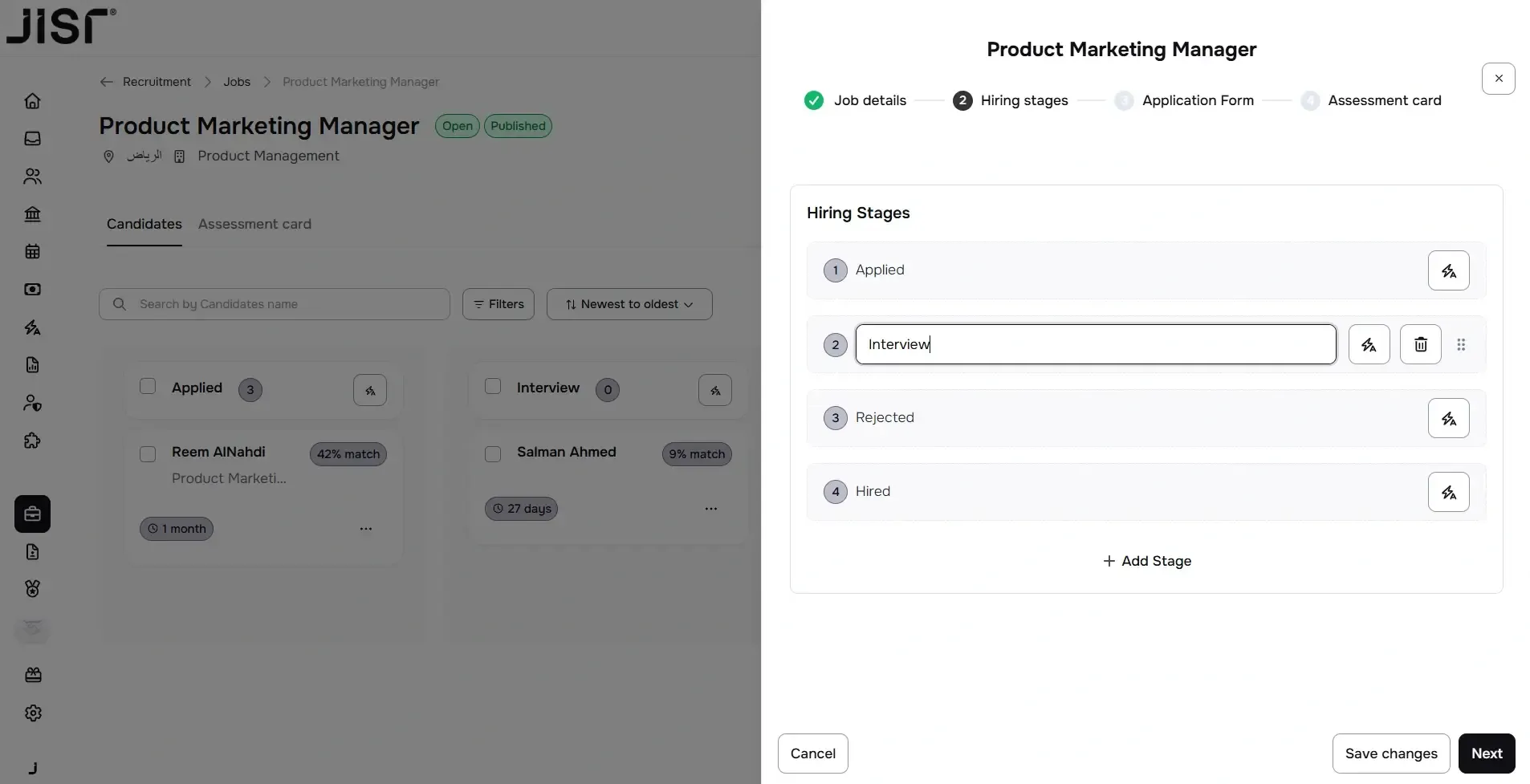
Instead of scattering your hiring process across emails, Excel files, and WhatsApp, Jisr brings every stage of hiring together in one place. The department manager submits the job requisition, the CFO approves, and the hiring team posts the ad, screens applications, coordinates interviews, and sends the final offer, all within a single system with a complete, connected record.
2. A Careers Page in Your Company's Identity, Reflecting Your Work Culture
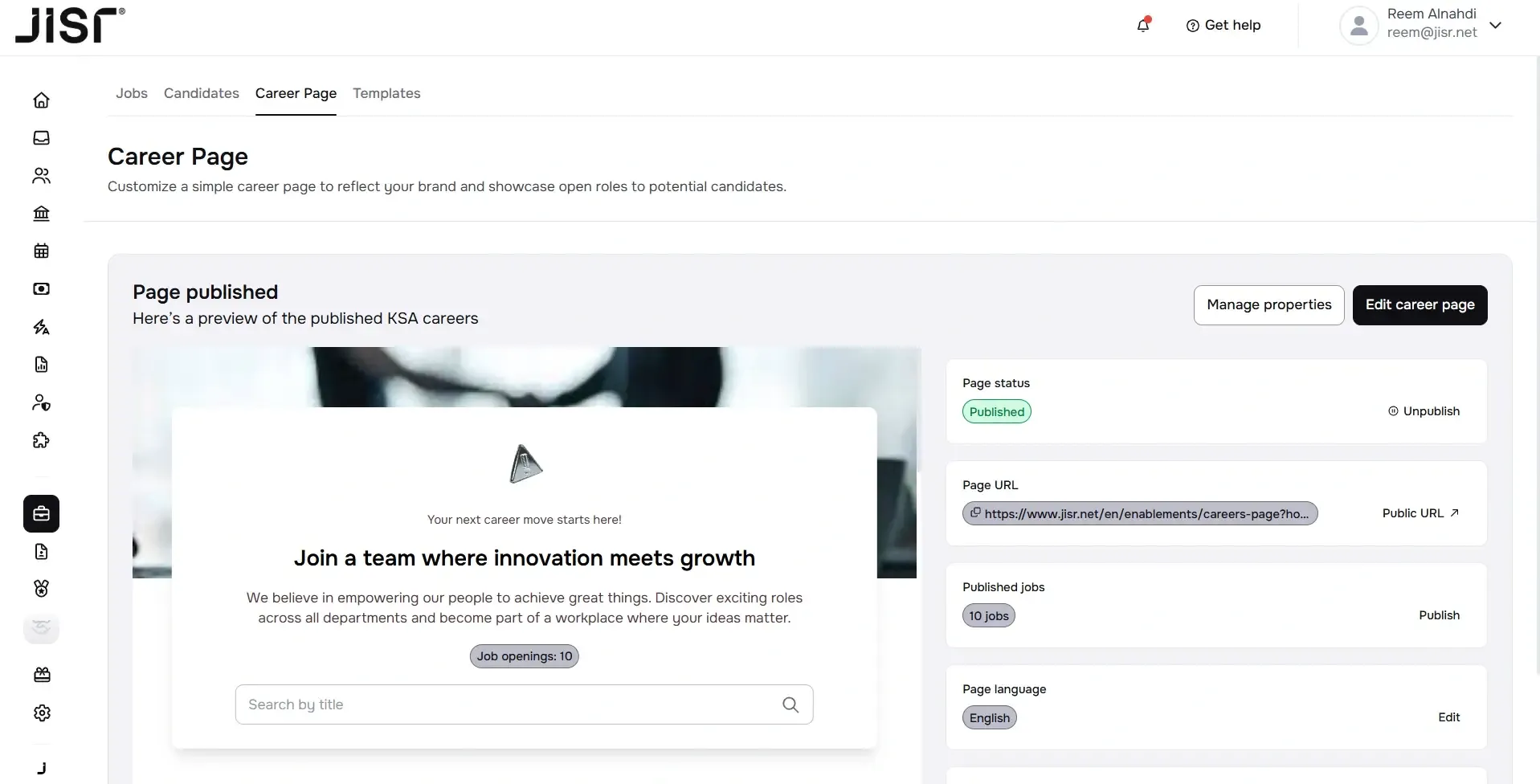
Your employer brand is like your commercial brand. Jisr lets you build a custom careers page in your company's identity (logo, colors, photos of the work environment, employee testimonials), connect it to your website's domain, optimize it for search engines, and display it smoothly on mobile, where 67% of Saudi candidates apply for jobs from their phones.
3. Posting Ads Across Every Platform With a Single Click
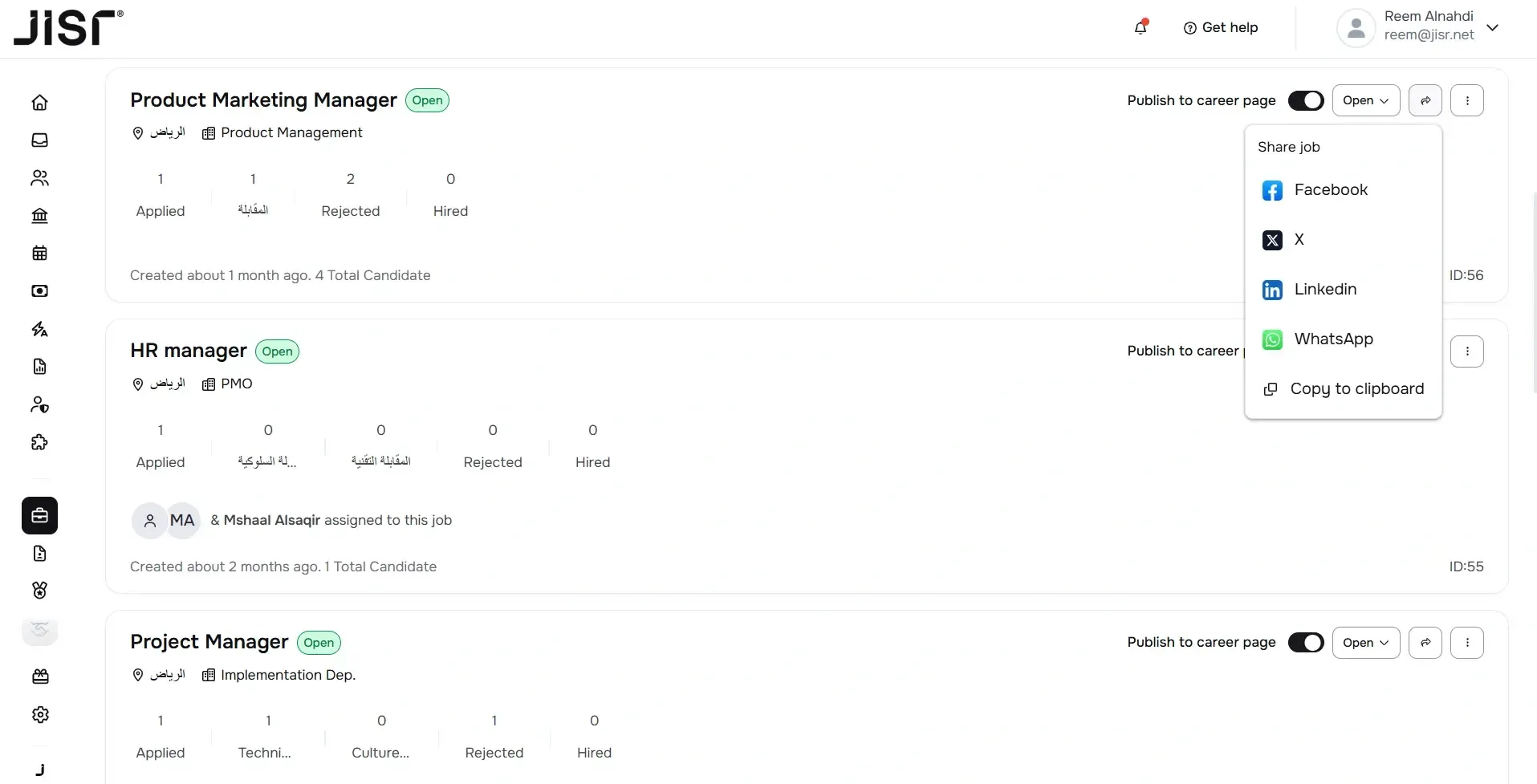
Jisr integrates directly with the most important recruitment platforms in the Saudi and regional markets. You write the ad once, choose the platforms, and it publishes automatically. You then track each channel's performance from a unified dashboard: how many candidates came from each platform and the quality of those candidates.
4. Smart AI Screening That Understands Arabic
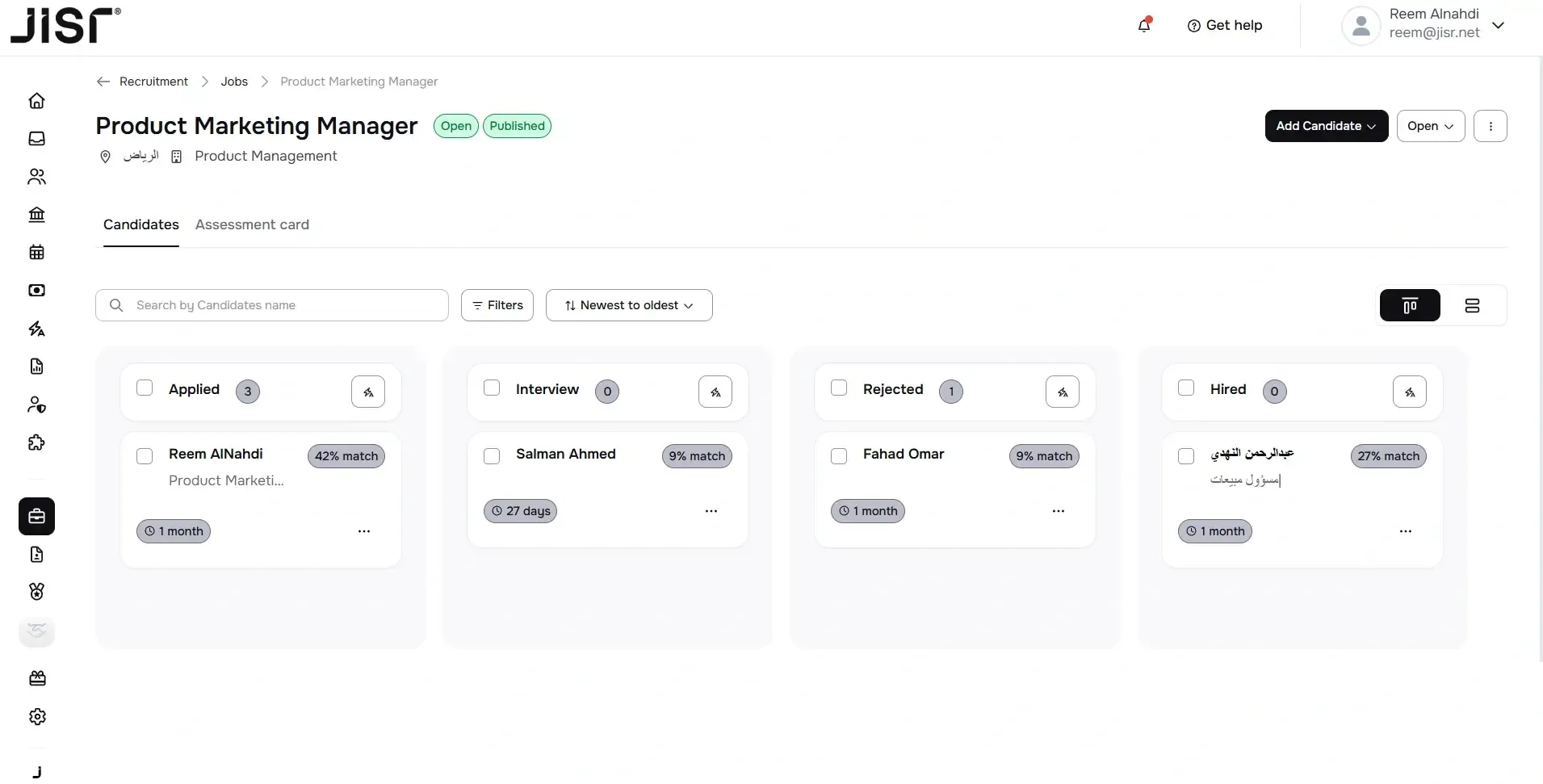
Most global systems fail to screen Arabic CVs accurately. Jisr is built specifically for the Saudi market: it understands the language, accurately extracts data, and ranks candidates by their fit for the job description.
5. Interview Scheduling Without the Chaos
Jisr integrates with the calendars of the hiring team and department managers, sends candidates links to choose a suitable time from the available slots, sends automatic reminders, and, if the interview is online, automatically creates a Zoom, Teams, or Meet link. All of this without back-and-forth WhatsApp messages or lost email chains.
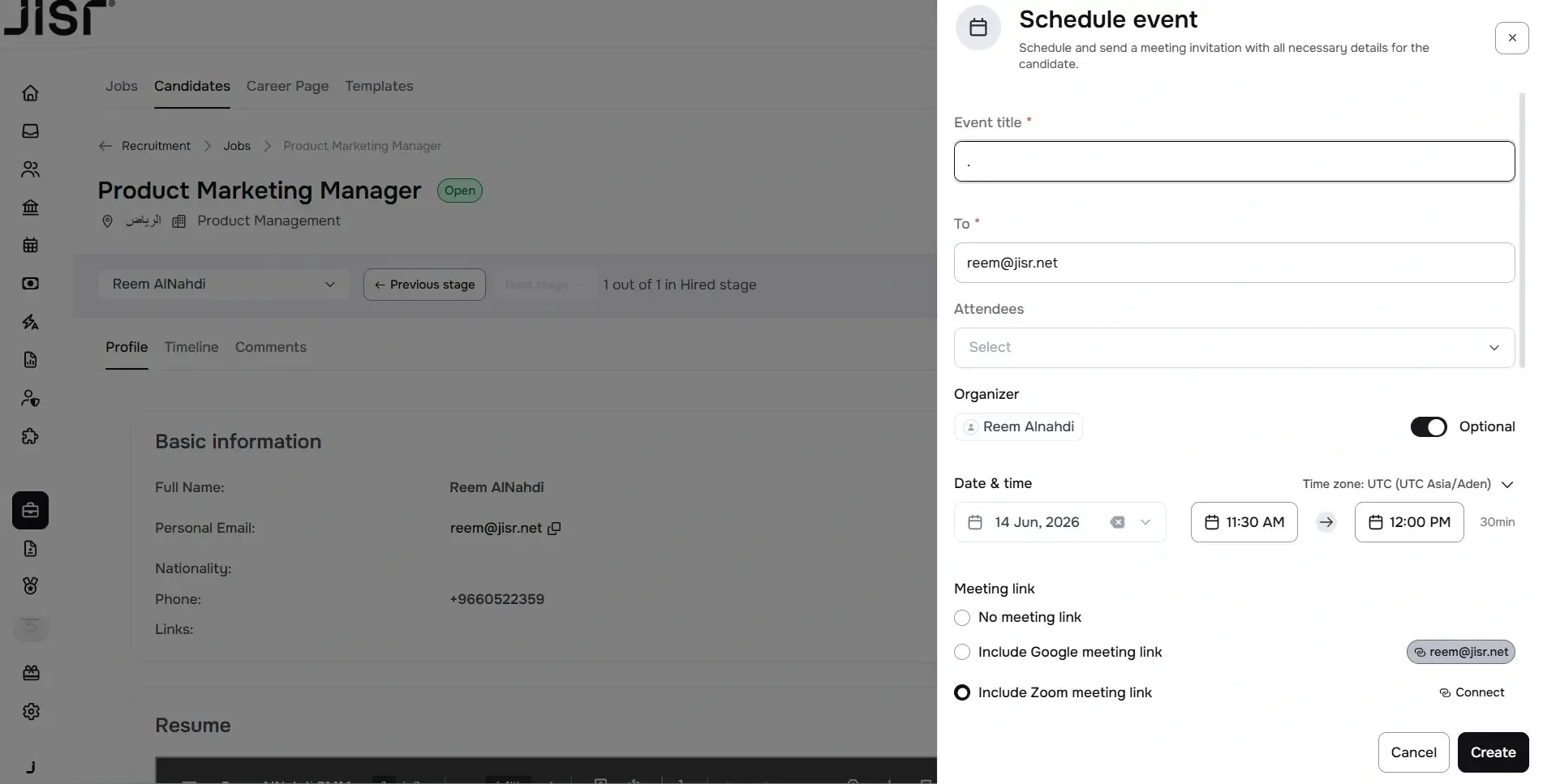
6. Data That Serves Your Decisions, Not Just Displays Numbers
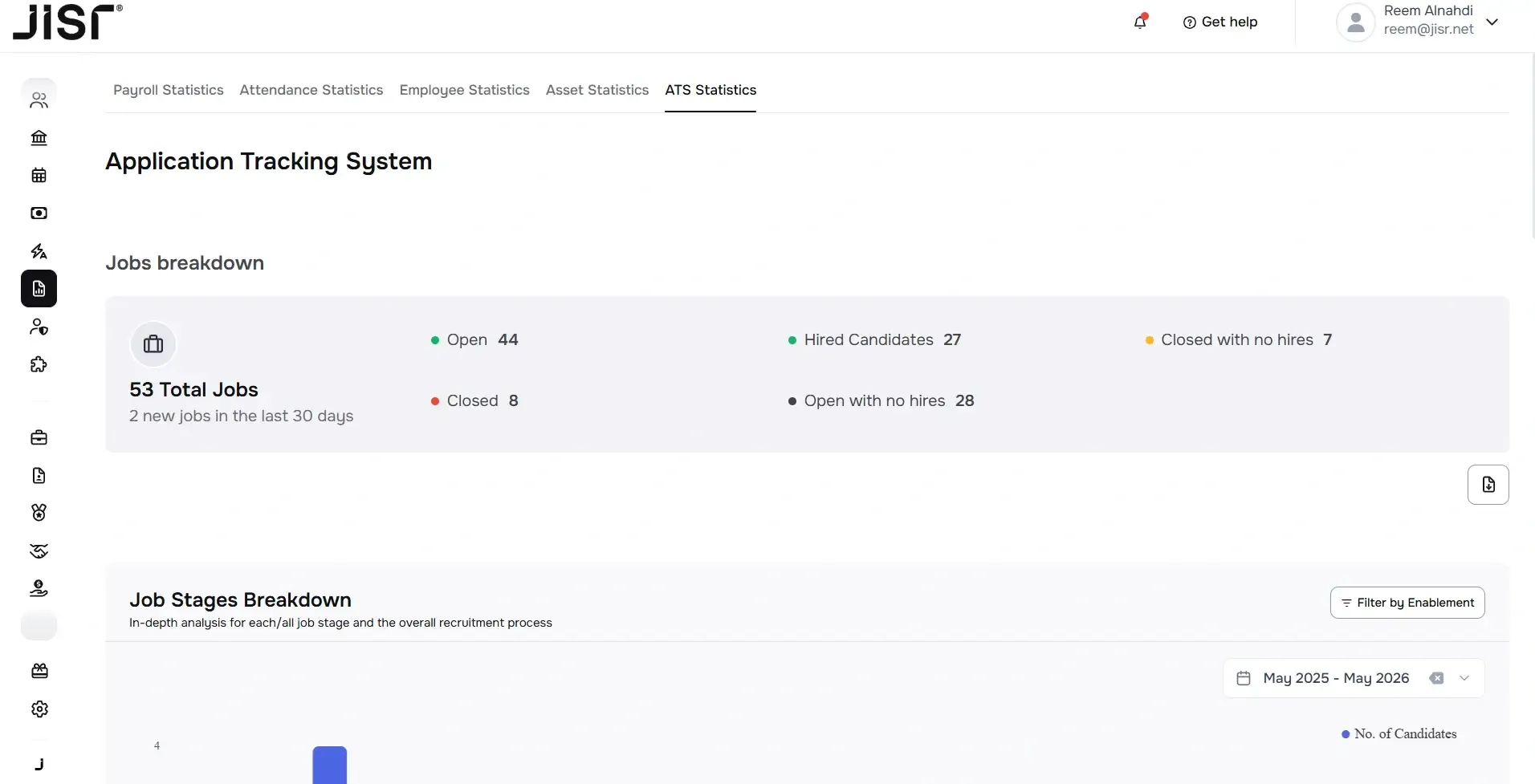
Jisr gives you a reporting dashboard that answers the questions that actually matter to you: how long does it take to fill each role? Which channel is best in terms of quality, not quantity? At which stage do candidates drop out the most? How does the current Saudization rate compare to the Nitaqat target? Which recruiters have the best performance? The reports are customizable to each role's needs, so the executive sees the strategic metrics, the HR manager sees operational performance, and the recruiter sees their daily task list.
Conclusion
An applicant tracking system (ATS) has moved from a nice-to-have to the backbone of a serious hiring function. It replaces a process scattered across email, WhatsApp, and Excel with a single, measurable workflow that runs from job requisition to signed offer, automating CV screening, protecting the candidate experience, and giving you a clear view of every hiring decision and what it costs.
FAQs
An applicant tracking system focuses on the pre-hire stage: posting jobs, attracting candidates, screening CVs, scheduling interviews, and managing offers. A core HR system, by contrast, covers the post-hire stages: employee files, payroll, attendance, leave, performance reviews, offboarding, and more. Put simply, applicant tracking systems manage candidates, and HR systems manage employees. Many systems, such as Jisr, offer both within a single platform that covers the entire employee lifecycle.
No, the system itself is not mandatory. But current regulations indirectly require the use of digital solutions to manage hiring. For example, documenting contracts on the Qiwa platform has become a core compliance requirement, and documentation rates affect the Nitaqat program.
The cost varies by company size and system depth, but in general: small companies, from SAR 200 to SAR 800 per month; medium companies, from SAR 800 to SAR 4,000 per month; and large companies, from SAR 4,000 to SAR 15,000+ per month. These figures cover the subscription only. The actual cost includes implementation, training, integrations, and support. In many cases, these costs equal or exceed the value of the subscription. So, from the outset, ask for a total cost over three years, not just the monthly price.
No. The reality points to a change like the work, not its replacement. The systems take over repetitive tasks such as screening, scheduling, and organizing data. In return, the hiring team's role concentrates on the more important aspects: building relationships, evaluating candidates, and making decisions. In other words, the recruiter's role shifts from an operational one to a strategic one.
Support varies significantly between systems, and can be divided into: surface translation, where the interface is in Arabic, but the system actually runs in English; and functional support, which supports Arabic CVs, right-to-left orientation, and bilingual ads. This last level is rare and is usually found in systems built for the local market, such as Jisr. The best way to verify is to request a demo using Arabic CVs, not ready-made samples, so you can see how the system handles them.
There are three main approaches: no integration, where data is entered by hand after each hire; via a third party, where the connection exists but updates are delayed; and direct integration, where the system is connected directly to the government platforms and is updated continuously.
It depends on the company's size: small companies, from 1 to 4 weeks; medium companies, from 4 to 8 weeks; and large companies, from 8 to 16 weeks, and it may extend to several months.
Related Blogs
 Recruitment
The ATS Scan Resume Guide for Recruiter and Candidate
 Recruitment
Talent Acquisition vs. Recruitment: What's the Difference and Why It Matters
 Recruitment
Job Posting Best Practices: How to Write Job Ads That Convert
Stay up-to-date with the latest HR trends, technologies, and tips!
Looking for the latest insights on HR topics like hiring, performance, metrics, and more? Receive the latest insights to help you find, onboard, develop, and retain your employees in your inbox now.